
Sat, Oct 3, 2026

Volume 20, Issue 3 (May-Jun 2026)
mljgoums 2026, 20(3): 2-5 |
Back to browse issues page


Download citation:
BibTeX | RIS | EndNote | Medlars | ProCite | Reference Manager | RefWorks
Send citation to:


BibTeX | RIS | EndNote | Medlars | ProCite | Reference Manager | RefWorks
Send citation to:
Oshim I O, Azi S O, Aniokete U C, Okekpa S I, Urama E U, Okoroiwu H U, et al . Prevalence of malaria and risk factors associated with symptomatic malaria among pregnant women attending antenatal care in South-South, Nigeria. mljgoums 2026; 20 (3) :2-5
URL: http://mlj.goums.ac.ir/article-1-1871-en.html
URL: http://mlj.goums.ac.ir/article-1-1871-en.html
Ifeanyi O. Oshim1 

 , Simon O. Azi2 , Ugonna C. Aniokete2 , Simon I. Okekpa3 , Evelyn U. Urama4 , Henshaw U. Okoroiwu3 , Promise U. Mbah5 , Lazarus A. Okoye6
, Simon O. Azi2 , Ugonna C. Aniokete2 , Simon I. Okekpa3 , Evelyn U. Urama4 , Henshaw U. Okoroiwu3 , Promise U. Mbah5 , Lazarus A. Okoye6
1- Department of Medical Laboratory Science, Faculty of Health Sciences and Technology, David Umahi Federal University of Health Sciences, Uburu, Ebonyi State, Nigeria; International Institute for Oncology, David Umahi Federal University of Health Sciences, PMB 211, Uburu Ebonyi State, Nigeria , oshimio@dufuhs.edu.ng
2- Department of Medical Laboratory Science, Faculty of Health Sciences and Technology, David Umahi Federal University of Health Sciences, Uburu, Ebonyi State, Nigeria; International Institute of Infectious Disease, Biosafety and Biosecurity, David Umahi Federal University of Health Sciences, PMB 211, Uburu Ebonyi State, Nigeria
3- Department of Medical Laboratory Science, Faculty of Health Sciences and Technology, David Umahi Federal University of Health Sciences, Uburu, Ebonyi State, Nigeria; International Institute for Oncology, David Umahi Federal University of Health Sciences, PMB 211, Uburu Ebonyi State, Nigeria
4- Department of Medical Microbiology and Public Health, Faculty of Medical Laboratory Science, Nnamdi Azikiwe University, Nnewi Campus, Nnewi, Anambra State, Nigeria
5- Department of Medical Laboratory Science, Imo State University, Owerri, Imo State, Nigeria
6- Department of Medical Laboratory Science, Faculty of Allied Health Sciences, Caritas University, Amorji-Nike, Emene, Enugu State, Nigeria
2- Department of Medical Laboratory Science, Faculty of Health Sciences and Technology, David Umahi Federal University of Health Sciences, Uburu, Ebonyi State, Nigeria; International Institute of Infectious Disease, Biosafety and Biosecurity, David Umahi Federal University of Health Sciences, PMB 211, Uburu Ebonyi State, Nigeria
3- Department of Medical Laboratory Science, Faculty of Health Sciences and Technology, David Umahi Federal University of Health Sciences, Uburu, Ebonyi State, Nigeria; International Institute for Oncology, David Umahi Federal University of Health Sciences, PMB 211, Uburu Ebonyi State, Nigeria
4- Department of Medical Microbiology and Public Health, Faculty of Medical Laboratory Science, Nnamdi Azikiwe University, Nnewi Campus, Nnewi, Anambra State, Nigeria
5- Department of Medical Laboratory Science, Imo State University, Owerri, Imo State, Nigeria
6- Department of Medical Laboratory Science, Faculty of Allied Health Sciences, Caritas University, Amorji-Nike, Emene, Enugu State, Nigeria
Full-Text [PDF 334 kb]
(1657 Downloads)
| Abstract (HTML) (6755 Views)
Discussion
Understanding the factors contributing to malaria prevalence in pregnant women provides an opportunity to implement effective preventive measures and interventions, particularly in the context of Benin City. The prevalence of malaria density was lowest among pregnant women in their primigravida 28 (28.0%) and higher among those in their multigravida 62 (62.0 %), and the association was statistically significant (P<0.05). Analysis of the results of this study indicates that pregnant women who had been pregnant multiple times (Multigravida) had a higher infection rate than women who were pregnant for the first time (Primigravidae). This finding contradicts the findings of Agomo et al., (11), Takem and D'Alessandro (12), and WHO (13), Desai et al. (14), and Fried and Duffy (15), who reported that primigravidae were more prone to contracting malaria infection during pregnancy than multigravidae. This is because primigravidae lack immunity to fight malaria infection during pregnancy, whereas multigravidae have acquired immunity against malaria during pregnancy (15,16). Nevertheless, the outcome of this study was consistent with the research conducted by Suliman et al. (17) and Kiemde et al. (18), indicating that women with multiple pregnancies are the most vulnerable group and that the number of previous pregnancies does not influence protective immunity during pregnancy. The findings might be explained by the fact that women do not typically encounter regions with a high prevalence of the disease during their first pregnancy, but such exposure may be more common during subsequent pregnancies (17,18).
It was observed that the prevalence of malaria parasites among pregnant women taking antimalarial therapy was higher among those who had not been treated during the period of 1-5 months 60 (60%), followed by < 1 month 28 (28%), while the lowest prevalence was recorded at 6 months 12 (12%). This is in agreement with the findings of Umar et al. (19).
The study’s findings demonstrated that pregnant women aged 26-30 had the highest occurrence of malaria parasite infection, accounting for 43 (43%) malaria-infected women. The age group 31-35 followed closely with 22 (22 %) malaria-infected women, and women aged between 20-25 years and 36-40 years each had 15 (15%), whereas the lowest prevalence was observed among women aged 41-45, with 6 (6%) malaria-infected women. Nevertheless, the observed difference in the rate of malaria infection in relation to age was statistically significant. This study was consistent with the findings of Umar et al. (19), and Bolaji et al. (20), who concluded that the occurrence of malaria is not influenced by age. However, this study contrasts with the research conducted by Mangusho et al. (21) and Yusuf et al. (22). They found that pregnant teenagers and young adult women had a higher vulnerability to malaria infection than older expectant mothers. It has further been explained that older women acquire immunity to malaria over time due to frequent infections, leading to lower levels of malaria parasites in adult women (19,21).
There are two possible explanations for the increased occurrence of malaria infection in the 26-30 age bracket: first, a smaller proportion of pregnant women examined compared with other age groups, and second, the direct impact of previous pregnancies, as a considerable proportion of the study subjects may have been older and experienced mothers rather than younger, first-time mothers (18,22).
It was observed that malaria was higher among women in their first trimester (39%), second trimester (35.0 %), and third trimester (26.0 %), and the association was not statistically significant (P<0.05). This may be because, in many cases, women in the first trimester may not have been tested for pregnancy or malaria and may not have registered at a clinic where they could be tested, treated, and monitored.
Conclusion
Overall, the findings underscored the complex dynamics of malaria infection in pregnant women, influenced by age, gravidity, treatment timing, and gestational stage, thereby contributing to the understanding of malaria management in maternal health. Therefore, special attention should be given to pregnant women prone to these factors.
Acknowledgement
The authors express their gratitude to the management, antenatal clinic staff, and Medical Laboratory Scientist at Faith Mediplex Hospital, Benin City, South-South Nigeria for their assistance during sample collection, laboratory analysis, and data acquisition. We also thank all pregnant women who consented to participate in this study for their time and cooperation. Their contribution was invaluable to the successful completion of this research.
Funding Sources
The authors received no specific funding for this research. The study was conducted without financial support from any public, commercial, or not-for-profit funding agency.
Ethical Statement
Ethical approval was granted by the Faith Mediplex Hospital Ethical Committee (FMH/REC/VOL12024/16). Written informed consent was obtained from all participants following an explanation of the study’s purpose. Participants who tested positive were treated in accordance with national malaria treatment guidelines.
Conflicts of Interest
The authors declare that they have no known competing financial interests or personal relationships that could have influenced the work reported in this manuscript. They have no conflicts of interest to disclose.
Author Contributions
Conceptualization: I.O.O., S.O.A.; Methodology: I.O.O., S.O.A., S.I.O., E.U.U.; Investigation: I.O.O., S.O.A., U.C.A., E.U.U., P.U.M.; Data curation: I.O.O., U.C.A., P.U.M.; Formal analysis: I.O.O., S.I.O., H.U.O.; Validation: S.O.A., U.C.A., E.U.U., H.U.O., L.A.O.; Visualization: I.O.O.; Supervision: I.O.O., H.U.O., L.A.O.; Project administration: I.O.O., L.A.O.; Writing - Original draft: I.O.O.; Writing - Review and Editing: S.O.A., U.C.A., S.I.O., E.U.U., H.U.O., P.U.M., L.A.O. All authors have read and approved the final manuscript.
Data Availability Statement
The datasets generated and/or analyzed during the current study are not publicly available because they contain information that could compromise the privacy and confidentiality of the study participants. However, de-identified data are available from the corresponding author upon reasonable request and with permission from the relevant institutional ethics committee.
Use of Artificial Intelligence
Generative artificial intelligence (AI) was used solely to assist with language editing, grammar improvement, and enhancement of the manuscript’s clarity and organization of the manuscript. The AI tool was not used to generate, analyze, interpret, or validate the study data, nor was it involved in the study design or the formulation of the scientific conclusions. All AI-generated suggestions were critically reviewed, verified, and edited by the authors, who take full responsibility for the accuracy, integrity, and originality of the manuscript.
Full-Text: (317 Views)
Introduction
Malaria is a major global health concern. More than 200 million infections occur annually, and 400,000 deaths are predicted (1). More than 90% of cases and fatalities worldwide occur in Sub-Saharan Africa, which bears a disproportionate burden of the disease.
Plasmodium falciparum (P. falciparum), the parasite responsible for the deadliest form of malaria, poses a significant threat to pregnant women, particularly in sub-Saharan Africa (2). During pregnancy, women are more susceptible to P. falciparum infection because of changes in the immune system, which can lead to severe consequences for both the mother and the fetus (3). Transmission of P. falciparum during pregnancy occurs through the bite of an infected female Anopheles mosquito (2). Once infection occurs, the parasite can invade the placenta, leading to placental malaria, which can cause inflammation and damage to the placenta and thereby affect fetal growth and development (3).
About 50 million pregnant women live in malaria-endemic areas, making pregnancy-related malaria a serious public health concern (4).
The P. falciparum parasite is more common in peripheral and placental blood under high-transmission settings, and it is more frequent in first-time pregnancies than in subsequent pregnancies. P. falciparum has a well-established epidemiological pattern, with a higher incidence in the early stages of pregnancy that increases if treatment is not received and subsequently decreases as gestation progresses (5). If left untreated, nearly all primigravidae in stable high-transmission areas are likely to become infected during the early stages of pregnancy; of these, about half would still be infected at delivery. The development of parity-specific immunity in multigravidae, particularly at higher parities, significantly reduces prevalence (6).
Malaria control remains a challenge in Africa, where the disease is endemic in 45 countries, including Nigeria, and 588 million people are at risk (7). Many National Malaria Control Programmes (NMCP) have shown particular interest in protecting pregnant women living in malaria-endemic areas because of their weakened immunity. In regions where malaria transmission is stable, most cases of malaria in pregnancy are asymptomatic (8). Such NMCP strategies include insecticide-treated bed nets (ITNs), intermittent preventive treatment (IPT), and case management, which are crucial for reducing the transmission of P. falciparum during pregnancy (9).
This can be explained by anti-disease immunity developed from prior exposures, which protects against clinical malaria. However, this subclinical condition still poses a significant risk of infection for both the mother and the fetus. The primary effects of malaria infection are caused by parasites in the placenta, resulting in low birth weight and maternal anemia, which can be fatal in severe cases (10).
The most prevalent malarial species in Africa, P. falciparum, is the primary cause of malaria during pregnancy. Regular exposure leads to the development of potent anti-disease immunity that inhibits the pro-inflammatory responses responsible for disease and prevents potentially fatal parasite burdens (11). Thus, the purpose of this study was to evaluate the characteristics associated with the prevalence of malaria among symptomatic pregnant women receiving antenatal care at a health facility in South-South, Nigeria.
Methods
Study design
A hospital-based cross-sectional study was conducted at Faith Mediplex Hospital, Benin City, South-South, Nigeria, from April to May, 2024.
Dependent and independent variables
The dependent variable was malaria infection status. The independent variables were age, residence, educational status, occupation, gestational age, gravidity, and distance from health centers.
Operational definitions
Symptomatic: Women who had at least one sign or symptom of malaria, such as chills, joint pain, fever (Axillary temperature ≥ 37.5°C), vomiting, or malaise.
Pregnant: Women confirmed to be positive for urine Human Chorionic Gonadotropin (HCG) hormone in the laboratory.
Data collection and processing
Clinical and socio-demographic data were collected from women confirmed as pregnant by a urine Human Chorionic Gonadotropin hormone test in the laboratory and attending follow-up care. Therefore, pregnant women exhibiting signs and/or symptoms of malaria during their visit were asked about their willingness to participate in the study. Among the pregnant women who volunteered, clinical and socio-demographic data were collected through face-to-face interviews conducted by midwives using a structured questionnaire.
For blood sample collection and the detection and identification of Plasmodium species, capillary blood was collected by trained and experienced medical laboratory scientists from each health center and by the principal investigator. Each pregnant woman’s finger was cleaned with 70% ethyl alcohol, and the side of the fingertip was pricked with a sterile lancet. The first drop of blood, which contains tissue fluids, was wiped away. One μl and 2 μl of blood were used to prepare thin and thick blood films, respectively. The prepared blood films were air-dried, and the thin films were fixed with absolute methanol. The smears were then stained with 10% Giemsa stain and examined under a light microscope following standard operating procedures. A negative result was reported after checking at least 100 oil immersion fields. Thick blood films were used for parasite detection, and thin blood films were used for species identification.
Data quality control
Before data collection began, training was provided to data collectors (Midwives and medical laboratory scientists) by the principal investigator on how to collect socio-demographic and clinical data and process laboratory data. To ensure the quality of the Giemsa stain, a high-quality Giemsa stock solution prepared at the Amhara Public Health Institute (APHI) was used to prepare 10% Giemsa working solution, which was prepared every 8 hours. Buffered water with a pH value of 7.2 was used to prepare the Giemsa stain working solution and was filtered before use. At the end of data collection, all slides were re-examined by experienced malaria microscopists at Faith Mediplex Hospital who had not been involved in data collection. This review (Re-examination) was considered final.
Data analysis
The questionnaire containing socio-demographic characteristics, clinical data, and associated factors was checked for completeness. The data were coded, entered, cleaned, and analyzed using the Statistical Package for Social Sciences version 27 (SPSS 27).
Descriptive statistics (Frequencies, mean, and percentage) were used to describe the study participants in relation to the variables. The chi-square test was used to determine factors associated with malaria, and a P-value < 0.05 was considered statistically significant.
Ethical considerations
Ethical approval was obtained from the Faith Mediplex Hospital Ethical Committee (FMH/REC/VOL12024/16). Written informed consent was obtained from study participants after the data collectors explained the purpose of the study. Study participants with positive results were treated according to the national malaria treatment guideline.
Results
All 120 pregnant women with fever symptoms included in the study were subjected to blood smear examination, and the results were compared; 100 (83.3%) fever patients tested positive for malaria by blood smear examination, whereas 20 (16.7%) tested negative by blood smear examination.
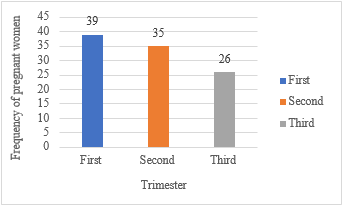
In terms of gravida status, the prevalence of malaria density was lowest among pregnant women in their primigravida (38.0%) and higher among those in their multigravida (62.0%), and the association was statistically significant (P<0.05). The prevalence of malaria parasite density among pregnant women who had taken antimalarial therapy showed the highest exposure during the period of 1-5 months (60%), followed by < 1 month (28%), while the lowest was recorded at 6 months (12%); this association was statistically significant (Figure 1). The study findings demonstrated that pregnant women aged 26-30 had the highest occurrence of malaria parasite infection, accounting for (43%) malaria-infected women. The age group 31-35 followed closely with (22 %) malaria-infected women, and women aged between 20-25 years and 36-40 years each had (15%), whereas the lowest prevalence was observed among women aged 41-45, with (6%) malaria-infected women. Nevertheless, the observed difference in the rate of malaria infection in relation to age was statistically significant (Figure 2). In terms of gestational age, malaria was higher among women in their first trimester (39%), second trimester (35.0 %), and third trimester (26.0 %), and the association was not statistically significant (P<0.05) (Figure 3). The study showed malaria parasite density with respect to the educational level of pregnant women; the secondary level accounted for 41%, while the tertiary level accounted for 51%, and the association was statistically significant (p-value = 0.081).
Malaria is a major global health concern. More than 200 million infections occur annually, and 400,000 deaths are predicted (1). More than 90% of cases and fatalities worldwide occur in Sub-Saharan Africa, which bears a disproportionate burden of the disease.
Plasmodium falciparum (P. falciparum), the parasite responsible for the deadliest form of malaria, poses a significant threat to pregnant women, particularly in sub-Saharan Africa (2). During pregnancy, women are more susceptible to P. falciparum infection because of changes in the immune system, which can lead to severe consequences for both the mother and the fetus (3). Transmission of P. falciparum during pregnancy occurs through the bite of an infected female Anopheles mosquito (2). Once infection occurs, the parasite can invade the placenta, leading to placental malaria, which can cause inflammation and damage to the placenta and thereby affect fetal growth and development (3).
About 50 million pregnant women live in malaria-endemic areas, making pregnancy-related malaria a serious public health concern (4).
The P. falciparum parasite is more common in peripheral and placental blood under high-transmission settings, and it is more frequent in first-time pregnancies than in subsequent pregnancies. P. falciparum has a well-established epidemiological pattern, with a higher incidence in the early stages of pregnancy that increases if treatment is not received and subsequently decreases as gestation progresses (5). If left untreated, nearly all primigravidae in stable high-transmission areas are likely to become infected during the early stages of pregnancy; of these, about half would still be infected at delivery. The development of parity-specific immunity in multigravidae, particularly at higher parities, significantly reduces prevalence (6).
Malaria control remains a challenge in Africa, where the disease is endemic in 45 countries, including Nigeria, and 588 million people are at risk (7). Many National Malaria Control Programmes (NMCP) have shown particular interest in protecting pregnant women living in malaria-endemic areas because of their weakened immunity. In regions where malaria transmission is stable, most cases of malaria in pregnancy are asymptomatic (8). Such NMCP strategies include insecticide-treated bed nets (ITNs), intermittent preventive treatment (IPT), and case management, which are crucial for reducing the transmission of P. falciparum during pregnancy (9).
This can be explained by anti-disease immunity developed from prior exposures, which protects against clinical malaria. However, this subclinical condition still poses a significant risk of infection for both the mother and the fetus. The primary effects of malaria infection are caused by parasites in the placenta, resulting in low birth weight and maternal anemia, which can be fatal in severe cases (10).
The most prevalent malarial species in Africa, P. falciparum, is the primary cause of malaria during pregnancy. Regular exposure leads to the development of potent anti-disease immunity that inhibits the pro-inflammatory responses responsible for disease and prevents potentially fatal parasite burdens (11). Thus, the purpose of this study was to evaluate the characteristics associated with the prevalence of malaria among symptomatic pregnant women receiving antenatal care at a health facility in South-South, Nigeria.
Methods
Study design
A hospital-based cross-sectional study was conducted at Faith Mediplex Hospital, Benin City, South-South, Nigeria, from April to May, 2024.
Dependent and independent variables
The dependent variable was malaria infection status. The independent variables were age, residence, educational status, occupation, gestational age, gravidity, and distance from health centers.
Operational definitions
Symptomatic: Women who had at least one sign or symptom of malaria, such as chills, joint pain, fever (Axillary temperature ≥ 37.5°C), vomiting, or malaise.
Pregnant: Women confirmed to be positive for urine Human Chorionic Gonadotropin (HCG) hormone in the laboratory.
Data collection and processing
Clinical and socio-demographic data were collected from women confirmed as pregnant by a urine Human Chorionic Gonadotropin hormone test in the laboratory and attending follow-up care. Therefore, pregnant women exhibiting signs and/or symptoms of malaria during their visit were asked about their willingness to participate in the study. Among the pregnant women who volunteered, clinical and socio-demographic data were collected through face-to-face interviews conducted by midwives using a structured questionnaire.
For blood sample collection and the detection and identification of Plasmodium species, capillary blood was collected by trained and experienced medical laboratory scientists from each health center and by the principal investigator. Each pregnant woman’s finger was cleaned with 70% ethyl alcohol, and the side of the fingertip was pricked with a sterile lancet. The first drop of blood, which contains tissue fluids, was wiped away. One μl and 2 μl of blood were used to prepare thin and thick blood films, respectively. The prepared blood films were air-dried, and the thin films were fixed with absolute methanol. The smears were then stained with 10% Giemsa stain and examined under a light microscope following standard operating procedures. A negative result was reported after checking at least 100 oil immersion fields. Thick blood films were used for parasite detection, and thin blood films were used for species identification.
Data quality control
Before data collection began, training was provided to data collectors (Midwives and medical laboratory scientists) by the principal investigator on how to collect socio-demographic and clinical data and process laboratory data. To ensure the quality of the Giemsa stain, a high-quality Giemsa stock solution prepared at the Amhara Public Health Institute (APHI) was used to prepare 10% Giemsa working solution, which was prepared every 8 hours. Buffered water with a pH value of 7.2 was used to prepare the Giemsa stain working solution and was filtered before use. At the end of data collection, all slides were re-examined by experienced malaria microscopists at Faith Mediplex Hospital who had not been involved in data collection. This review (Re-examination) was considered final.
Data analysis
The questionnaire containing socio-demographic characteristics, clinical data, and associated factors was checked for completeness. The data were coded, entered, cleaned, and analyzed using the Statistical Package for Social Sciences version 27 (SPSS 27).
Descriptive statistics (Frequencies, mean, and percentage) were used to describe the study participants in relation to the variables. The chi-square test was used to determine factors associated with malaria, and a P-value < 0.05 was considered statistically significant.
Ethical considerations
Ethical approval was obtained from the Faith Mediplex Hospital Ethical Committee (FMH/REC/VOL12024/16). Written informed consent was obtained from study participants after the data collectors explained the purpose of the study. Study participants with positive results were treated according to the national malaria treatment guideline.
Results
All 120 pregnant women with fever symptoms included in the study were subjected to blood smear examination, and the results were compared; 100 (83.3%) fever patients tested positive for malaria by blood smear examination, whereas 20 (16.7%) tested negative by blood smear examination.
In terms of gravida status, the prevalence of malaria density was lowest among pregnant women in their primigravida (38.0%) and higher among those in their multigravida (62.0%), and the association was statistically significant (P<0.05). The prevalence of malaria parasite density among pregnant women who had taken antimalarial therapy showed the highest exposure during the period of 1-5 months (60%), followed by < 1 month (28%), while the lowest was recorded at 6 months (12%); this association was statistically significant (Figure 1). The study findings demonstrated that pregnant women aged 26-30 had the highest occurrence of malaria parasite infection, accounting for (43%) malaria-infected women. The age group 31-35 followed closely with (22 %) malaria-infected women, and women aged between 20-25 years and 36-40 years each had (15%), whereas the lowest prevalence was observed among women aged 41-45, with (6%) malaria-infected women. Nevertheless, the observed difference in the rate of malaria infection in relation to age was statistically significant (Figure 2). In terms of gestational age, malaria was higher among women in their first trimester (39%), second trimester (35.0 %), and third trimester (26.0 %), and the association was not statistically significant (P<0.05) (Figure 3). The study showed malaria parasite density with respect to the educational level of pregnant women; the secondary level accounted for 41%, while the tertiary level accounted for 51%, and the association was statistically significant (p-value = 0.081).
.PNG)
.PNG)
Discussion
Understanding the factors contributing to malaria prevalence in pregnant women provides an opportunity to implement effective preventive measures and interventions, particularly in the context of Benin City. The prevalence of malaria density was lowest among pregnant women in their primigravida 28 (28.0%) and higher among those in their multigravida 62 (62.0 %), and the association was statistically significant (P<0.05). Analysis of the results of this study indicates that pregnant women who had been pregnant multiple times (Multigravida) had a higher infection rate than women who were pregnant for the first time (Primigravidae). This finding contradicts the findings of Agomo et al., (11), Takem and D'Alessandro (12), and WHO (13), Desai et al. (14), and Fried and Duffy (15), who reported that primigravidae were more prone to contracting malaria infection during pregnancy than multigravidae. This is because primigravidae lack immunity to fight malaria infection during pregnancy, whereas multigravidae have acquired immunity against malaria during pregnancy (15,16). Nevertheless, the outcome of this study was consistent with the research conducted by Suliman et al. (17) and Kiemde et al. (18), indicating that women with multiple pregnancies are the most vulnerable group and that the number of previous pregnancies does not influence protective immunity during pregnancy. The findings might be explained by the fact that women do not typically encounter regions with a high prevalence of the disease during their first pregnancy, but such exposure may be more common during subsequent pregnancies (17,18).
It was observed that the prevalence of malaria parasites among pregnant women taking antimalarial therapy was higher among those who had not been treated during the period of 1-5 months 60 (60%), followed by < 1 month 28 (28%), while the lowest prevalence was recorded at 6 months 12 (12%). This is in agreement with the findings of Umar et al. (19).
The study’s findings demonstrated that pregnant women aged 26-30 had the highest occurrence of malaria parasite infection, accounting for 43 (43%) malaria-infected women. The age group 31-35 followed closely with 22 (22 %) malaria-infected women, and women aged between 20-25 years and 36-40 years each had 15 (15%), whereas the lowest prevalence was observed among women aged 41-45, with 6 (6%) malaria-infected women. Nevertheless, the observed difference in the rate of malaria infection in relation to age was statistically significant. This study was consistent with the findings of Umar et al. (19), and Bolaji et al. (20), who concluded that the occurrence of malaria is not influenced by age. However, this study contrasts with the research conducted by Mangusho et al. (21) and Yusuf et al. (22). They found that pregnant teenagers and young adult women had a higher vulnerability to malaria infection than older expectant mothers. It has further been explained that older women acquire immunity to malaria over time due to frequent infections, leading to lower levels of malaria parasites in adult women (19,21).
There are two possible explanations for the increased occurrence of malaria infection in the 26-30 age bracket: first, a smaller proportion of pregnant women examined compared with other age groups, and second, the direct impact of previous pregnancies, as a considerable proportion of the study subjects may have been older and experienced mothers rather than younger, first-time mothers (18,22).
It was observed that malaria was higher among women in their first trimester (39%), second trimester (35.0 %), and third trimester (26.0 %), and the association was not statistically significant (P<0.05). This may be because, in many cases, women in the first trimester may not have been tested for pregnancy or malaria and may not have registered at a clinic where they could be tested, treated, and monitored.
Conclusion
Overall, the findings underscored the complex dynamics of malaria infection in pregnant women, influenced by age, gravidity, treatment timing, and gestational stage, thereby contributing to the understanding of malaria management in maternal health. Therefore, special attention should be given to pregnant women prone to these factors.
Acknowledgement
The authors express their gratitude to the management, antenatal clinic staff, and Medical Laboratory Scientist at Faith Mediplex Hospital, Benin City, South-South Nigeria for their assistance during sample collection, laboratory analysis, and data acquisition. We also thank all pregnant women who consented to participate in this study for their time and cooperation. Their contribution was invaluable to the successful completion of this research.
Funding Sources
The authors received no specific funding for this research. The study was conducted without financial support from any public, commercial, or not-for-profit funding agency.
Ethical Statement
Ethical approval was granted by the Faith Mediplex Hospital Ethical Committee (FMH/REC/VOL12024/16). Written informed consent was obtained from all participants following an explanation of the study’s purpose. Participants who tested positive were treated in accordance with national malaria treatment guidelines.
Conflicts of Interest
The authors declare that they have no known competing financial interests or personal relationships that could have influenced the work reported in this manuscript. They have no conflicts of interest to disclose.
Author Contributions
Conceptualization: I.O.O., S.O.A.; Methodology: I.O.O., S.O.A., S.I.O., E.U.U.; Investigation: I.O.O., S.O.A., U.C.A., E.U.U., P.U.M.; Data curation: I.O.O., U.C.A., P.U.M.; Formal analysis: I.O.O., S.I.O., H.U.O.; Validation: S.O.A., U.C.A., E.U.U., H.U.O., L.A.O.; Visualization: I.O.O.; Supervision: I.O.O., H.U.O., L.A.O.; Project administration: I.O.O., L.A.O.; Writing - Original draft: I.O.O.; Writing - Review and Editing: S.O.A., U.C.A., S.I.O., E.U.U., H.U.O., P.U.M., L.A.O. All authors have read and approved the final manuscript.
Data Availability Statement
The datasets generated and/or analyzed during the current study are not publicly available because they contain information that could compromise the privacy and confidentiality of the study participants. However, de-identified data are available from the corresponding author upon reasonable request and with permission from the relevant institutional ethics committee.
Use of Artificial Intelligence
Generative artificial intelligence (AI) was used solely to assist with language editing, grammar improvement, and enhancement of the manuscript’s clarity and organization of the manuscript. The AI tool was not used to generate, analyze, interpret, or validate the study data, nor was it involved in the study design or the formulation of the scientific conclusions. All AI-generated suggestions were critically reviewed, verified, and edited by the authors, who take full responsibility for the accuracy, integrity, and originality of the manuscript.
Research Article: Research Article |
Subject:
Parasitology
Received: 2024/10/6 | Accepted: 2025/06/11 | Published: 2026/06/8 | ePublished: 2026/06/8
Received: 2024/10/6 | Accepted: 2025/06/11 | Published: 2026/06/8 | ePublished: 2026/06/8
References
1. Oladipo HJ, Tajudeen YA, Oladunjoye IO, Yusuff SI, Yusuf RO, Oluwaseyi EM, et al. Increasing challenges of malaria control in sub-Saharan Africa: Priorities for public health research and policymakers. Ann Med Surg (Lond). 2022:81:104366. [View at Publisher] [DOI] [Google Scholar]
2. Steketee RW, Nahlen BL, Parise ME, Menendez C. The burden of malaria in pregnancy in malaria-endemic areas. Am J Trop Med Hyg. 2001;64(1-2 Suppl):28-35. [View at Publisher] [DOI] [PMID] [Google Scholar]
3. Guyatt HL, Snow RW. Impact of malaria during pregnancy on low birth weight in sub-Saharan Africa. Clin Microbiol Rev. 2004;17(4):760-9, table of contents. [View at Publisher] [DOI] [PMID] [Google Scholar]
4. Badmos AO, Alaran AJ, Adebisi YA, Bouaddi O, Onibon Z, Dada A, et al. What sub-Saharan African countries can learn from malaria elimination in China. Trop Med Health. 2021;49(1):86. [View at Publisher] [DOI] [PMID] [Google Scholar]
5. World Health Organization. A strategic framework for malaria prevention and control during pregnancy in the African region. World Health Organization Regional Office for Africa Brazzaville. 2004. [View at Publisher] [Google Scholar]
6. Shulman CE, Dorman EK. Importance and prevention of malaria in pregnancy. Trans R Soc Trop Med Hyg. 2003;97(1):30-5. [View at Publisher] [DOI] [PMID] [Google Scholar]
7. Fried M, Domingo GJ, Gowda CD, Mutabingwa TK, Duffy PE. Plasmodium falciparum: chondroitin sulfate A is the major receptor for adhesion of parasitized erythrocytes in the placenta. Exp Parasitol. 2006;113(1):36-42. [View at Publisher] [DOI] [PMID] [Google Scholar]
8. Agomo CO, Oyibo WA, Anorlu RI, Agomo PU. Prevalence of malaria in pregnant women in Lagos, South-West Nigeria. Korean J Parasitol. 2009;47(2):179-83. [View at Publisher] [DOI] [PMID] [Google Scholar]
9. Borgella S, Fievet N, Huynh B-T, Ibitokou S, Hounguevou G, Affedjou J, et al. Impact of Pregnancy-Associated Malaria on Infant Malaria Infection in Southern Benin. PLOS ONE. 2013;8(11): e80624 [View at Publisher] [DOI] [PMID] [Google Scholar]
10. Fana SA, Bunza MDA, Anka SA, Imam AU, Nataala SU. Prevalence and risk factors associated with malaria infection among pregnant women in a semi-urban community of north-western Nigeria. Infect Dis Poverty. 2015:4:24. [View at Publisher] [DOI] [PMID] [Google Scholar]
11. Agomo CO, Oyibo WA. Factors associated with risk of malaria infection among pregnant women in Lagos, Nigeria. Infect Dis Poverty. 2013;2(1):19. [View at Publisher] [DOI] [PMID] [Google Scholar]
12. Takem EN, D'Alessandro U. Malaria in pregnancy. Mediterr J Hematol Infect Dis. 2013;5(1):e2013010. [View at Publisher] [DOI] [PMID] [Google Scholar]
13. World Health Organization (WHO). Malaria rapid diagnostic test performance: results of WHO product testing of malaria RDTs: round 8 (2016-2018). World Health Organization. 2015. [View at Publisher]
14. Desai M, O ter Kuile F, Nosten F, McGready R, Asamoa K, Brabin B, et al. Epidemiology and burden of malaria inpregnancy. Lancet Infect Dis. 2007;7(2):93-104. [View at Publisher] [DOI] [PMID] [Google Scholar]
15. Fried M, Duffy PE. Adherence of Plasmodium falciparum to chondroitin sulfate A in the human placenta. Science.1996;272(5267):1502–4. [View at Publisher] [DOI] [PMID] [Google Scholar]
16. Okoroiwu GIA. Prevalence of malaria and associated risk factors in pregnant women in mbaitoli local governmentarea, South-east Nigeria. Afr J Biomed Res. 2023;26(2):167-72. [View at Publisher] [DOI] [Google Scholar]
17. Suliman MA, Tamomh AG, Younis OY, Magboul AM, Mohammed HY, Hassan IM, et al. Malaria infection andassociated risk factors in pregnant women attending antenatal clinics in AI Jabalian locality, White Nile state, Sudan. Ann Parasitol. 2021;67(3):499-504. [View at Publisher] [DOI] [PMID] [Google Scholar]
18. Kiemde F, Sorgho H, Zango SH, Some GF, Rouamba T, Traore O, et al. Immunomodulatory effect of gestational age onblood cortisol and prolactin levels during pregnancy inmalaria endemic area. Res Square.2023;1:1-18. [View at Publisher] [DOI] [Google Scholar]
19. Umar S, Erhabor O, Abdulrahaman Y, Zama I, Onuigwe FU, Buhari H. Alterations in some hematological parameters, ascorbic acid and pantothenic acid levels among pregnant women with plasmodium parasitaemia in Sokoto, Nigeria. Sokoto Journal Laboratory Science. 2022;7(3):71-84 [View at Publisher] [DOI] [Google Scholar]
20. Bolaji O, Adekunle O, Adeyemo A, Ojewuyi A, Ajayi A, Rufai, A, et al. Prevalence of Plasmodium falciparium among pregnant women attending antenatal clinics in Osogbo, Osun State Nigeria. WNJMS. 2023;6(1):23-28 [View at Publisher] [Google Scholar]
21. Mangusho C, Mwebesa E, Izudi J, Aleni M, Driclle R, Ayaiasi RM, et al. High prevalence of malaria in pregnancy among women attending antenatal care at a large referral hospital in Northwestern Uganda: a cross-sectional study. PLoS ONE. 2023;18(4):0283755 [View at Publisher] [DOI] [PMID] [Google Scholar]
22. Yusuf F, Sadau Y, Natasha P, Lai I. Effects of Malaria Parasitemia on Hematological Parameters of Pregnant Women Attending Gombe Specialist Hospital. BJST. 2023;7(1):397. [View at Publisher] [DOI] [Google Scholar]
Send email to the article author
| Rights and permissions | |
 |
This work is licensed under a Creative Commons Attribution-NonCommercial 4.0 International License. |

This work is licensed under a Creative Commons Attribution-NonCommercial 4.0 International License.

Contact us
Tel & Fax: (+98) 17-32450093
E-mail:
 goums.ac.ir
 yahoo.com